Design for the circuit
Requirements had to reflect how enthusiasts prepare for, drive, record, and review a real session at a track.


Track Day Genius customer story · Motorsport telemetry
Avant Garde Associates partnered with Shinetech to build a native iOS product that brought circuit profiles, video, GPS, motion data, and performance analysis into one track-day experience.

About Track Day Genius
Track Day Genius is a mobile product created for track-day enthusiasts who want to record, understand, compare, and share their driving performance.
The situation
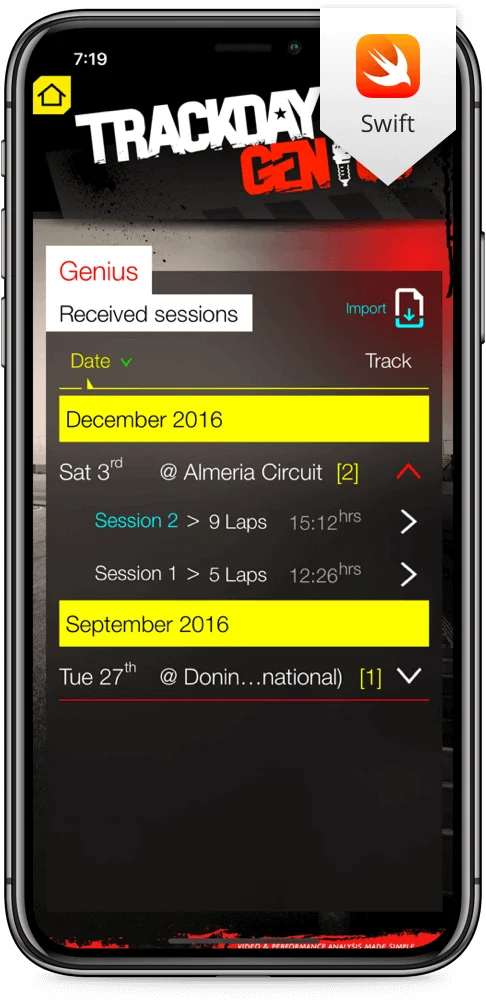
The product vision combined preloaded circuit profiles, video capture, and visual telemetry analysis for enthusiasts who wanted more than a stopwatch after a track session.
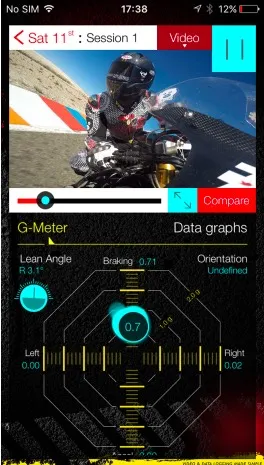
Users needed a clear way to review how speed, acceleration, G-force, slope, vehicle setup, and circuit position changed across laps and sectors.
The product challenge
The team needed to understand real track-day behavior before shaping the data model, architecture, capture flow, and review experience.
Requirements had to reflect how enthusiasts prepare for, drive, record, and review a real session at a track.
Video, GPS, speed, acceleration, G-force, slope, and vehicle profiles had to become one coherent session record.
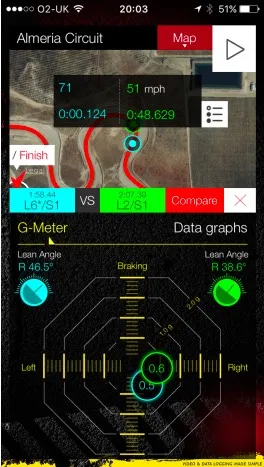
Predictions, graphs, maps, sector comparisons, and summaries needed to make performance differences easy to interpret.
The solution
Shinetech paired onshore product support with a distributed engineering team. Objective-C, C++, .NET Core, and GPS capabilities supported the mobile experience, while modular development kept capture, analysis, profiles, commerce, and sharing connected.
Visit circuits with the client and observe the environment, user expectations, and review journey directly.
Connect video, GPS, motion signals, circuit profiles, vehicle data, and telemetry calculations in a modular application framework.
Add predictive timing, comparisons, graphs, satellite views, in-app purchases, and sharing around the core session record.
Product interface
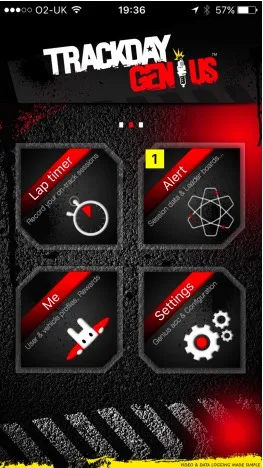
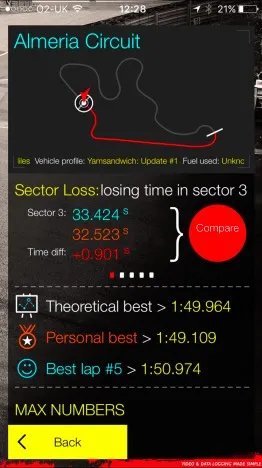
These Track Day Genius screens show the delivered interface and the types of feedback available to drivers.
How we worked
A London-based project lead also served as business analyst, working directly with the client while coordinating the distributed development team.
Track visits grounded product decisions in real user expectations instead of assumptions made away from the circuit.
Weekly demos, feedback, and Sprint planning helped every developer understand the overall product goal and take responsibility for quality.
Study track-day behavior and expectations.
Define the architecture and product modules.
Review working software every week.
Use feedback to shape the next Sprint.
Product demonstration
The product demonstration shows the relationship between recorded video, circuit position, vehicle data, and lap analysis.
The result
The application combined circuit profiles, video logging, speed, acceleration, G-force, slope, predictive lap timing, vehicle profiles, graphs, satellite views, and session summaries.
Video, circuit position, telemetry, and vehicle information gave users one place to revisit a run.
Predictions, graphs, maps, and comparisons turned measurements into understandable feedback.
In-app purchases, imported video, profiles, and sharing extended the experience around lap analysis.
Case taxonomy
Make field data useful
Get in touch
Tell us what you need to build, modernize, automate, or augment with AI. We can start with a focused discussion or a no-risk 1-week trial.

“A fantastic company to work with.” After the initial rapid development project, American Shipping Co. kept two Shinetech developers embedded for nearly four years, supporting internal and external tools and new AI initiatives.
 CEO, American Shipping Co. - 5-star Google Review