Portfolio context
The team worked across commerce and internal products with related users, rules, and integrations.


Property retail delivery case study
A property retail business needed a dependable Java team that could learn its domain, work inside established delivery practices, and improve e-commerce and internal applications over time.
The situation
The client operated customer-facing commerce and internal applications that supported property retail work. A short-term project model would repeatedly lose context across business rules, systems, and release practices.
The organization wanted an external team that could become part of its delivery system, retain product knowledge, and take responsibility for a steady portfolio of Java work.
The challenge
The partnership needed technical capability, delivery discipline, and enough continuity to understand the client's property retail domain.
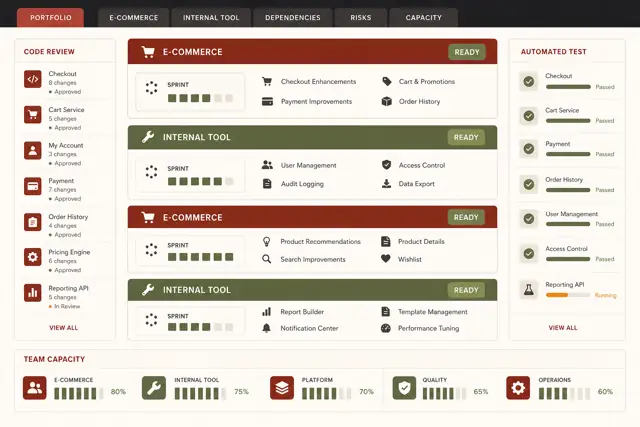
The team worked across commerce and internal products with related users, rules, and integrations.
Planning, review, and release needed to align with the client's Agile and scaled delivery practices.
Regular change required repeatable testing and code review rather than late stabilization.
The solution
The team combined product onboarding, shared planning, and continuous engineering practices to deliver across the application portfolio.
Retain knowledge of property retail workflows, users, applications, and integration dependencies.
Participate in shared planning, Kanban flow, reviews, and release coordination using the client's Agile model.
Use code review, automated tests, and incremental delivery to keep change predictable.
How we worked
Delivery priorities were managed through shared product backlogs rather than a separate vendor queue.
Stable team composition allowed lessons from one application or release to inform the next.
Quality checks and demonstrations were built into the working rhythm, helping stakeholders inspect progress continuously.
Learn products, domain rules, systems, and standards.
Join shared backlog and scaled delivery activities.
Build Java changes in small, reviewable increments.
Use testing and retrospectives to strengthen flow.
The result
The long-term model preserved domain knowledge, aligned external engineers with internal delivery practices, and supported a continuing portfolio of application work.
Continuity reduced the cost and risk of relearning complex products.
One backlog and delivery model kept priorities and accountability visible.
The team could support different Java applications while retaining portfolio context.
Case taxonomy
Build product capacity that retains context
Get in touch
Tell us what you need to build, modernize, automate, or augment with AI. We can start with a focused discussion or a no-risk 1-week trial.

“A fantastic company to work with.” After the initial rapid development project, American Shipping Co. kept two Shinetech developers embedded for nearly four years, supporting internal and external tools and new AI initiatives.
 CEO, American Shipping Co. - 5-star Google Review